TIG offers precision and low heat input for thin or high-quality joints, while MIG provides speed for thicker sections and production volume. The best choice depends on wall thickness, joint type, accessibility, and required finish.
- TIG welding produces cleaner joints with less heat distortion, making it suitable for thin walls and visible assemblies.
- MIG welding moves faster and handles thicker sections, but requires more setup and post-weld cleanup.
- Joint design and fit-up matter as much as the process, with gaps and edge preparation affecting both methods.
- Operator skill and equipment availability drive the final decision in most projects.
- Hybrid approaches, such as TIG for critical joints and MIG for bulk assembly, are common in fabrication.
Why the Process Choice Matters for Extruded Profiles
Extruded profiles present specific challenges that differ from flat plate or solid bar stock. The geometry of a channel, angle, or tube means heat can travel along the length of the part and concentrate at internal corners. Poor heat control leads to warp, burn-through, or weak joints that fail under load.
The welding method you pick changes how heat enters the metal, how quickly the pool solidifies, and what the final surface looks like. For extrusion welding methods, the two most common options for aluminum are TIG and MIG. Each works well under different conditions, and the best decision often depends on part dimensions, production volume, and quality requirements.
How TIG Welding Works on Aluminum
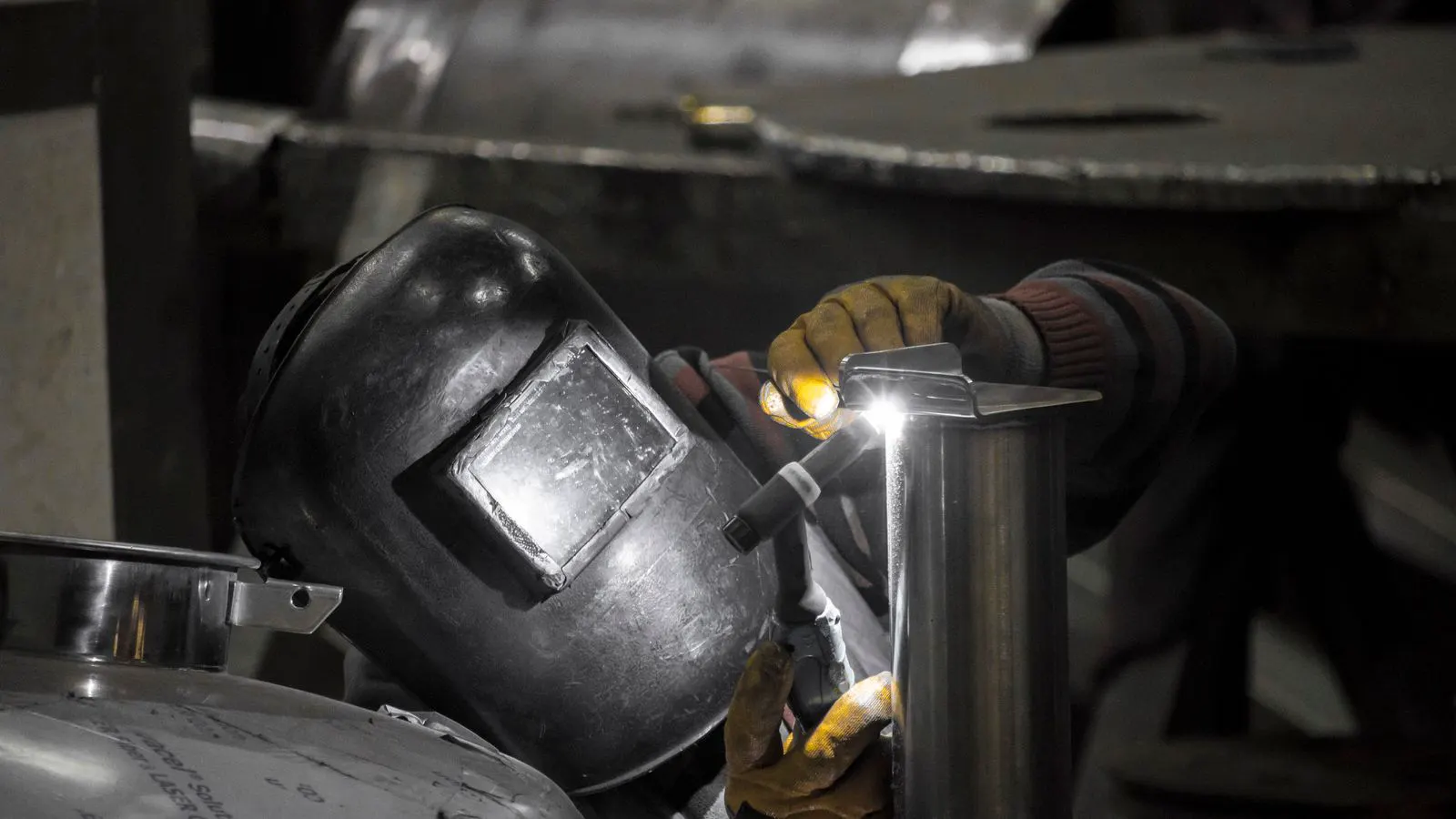
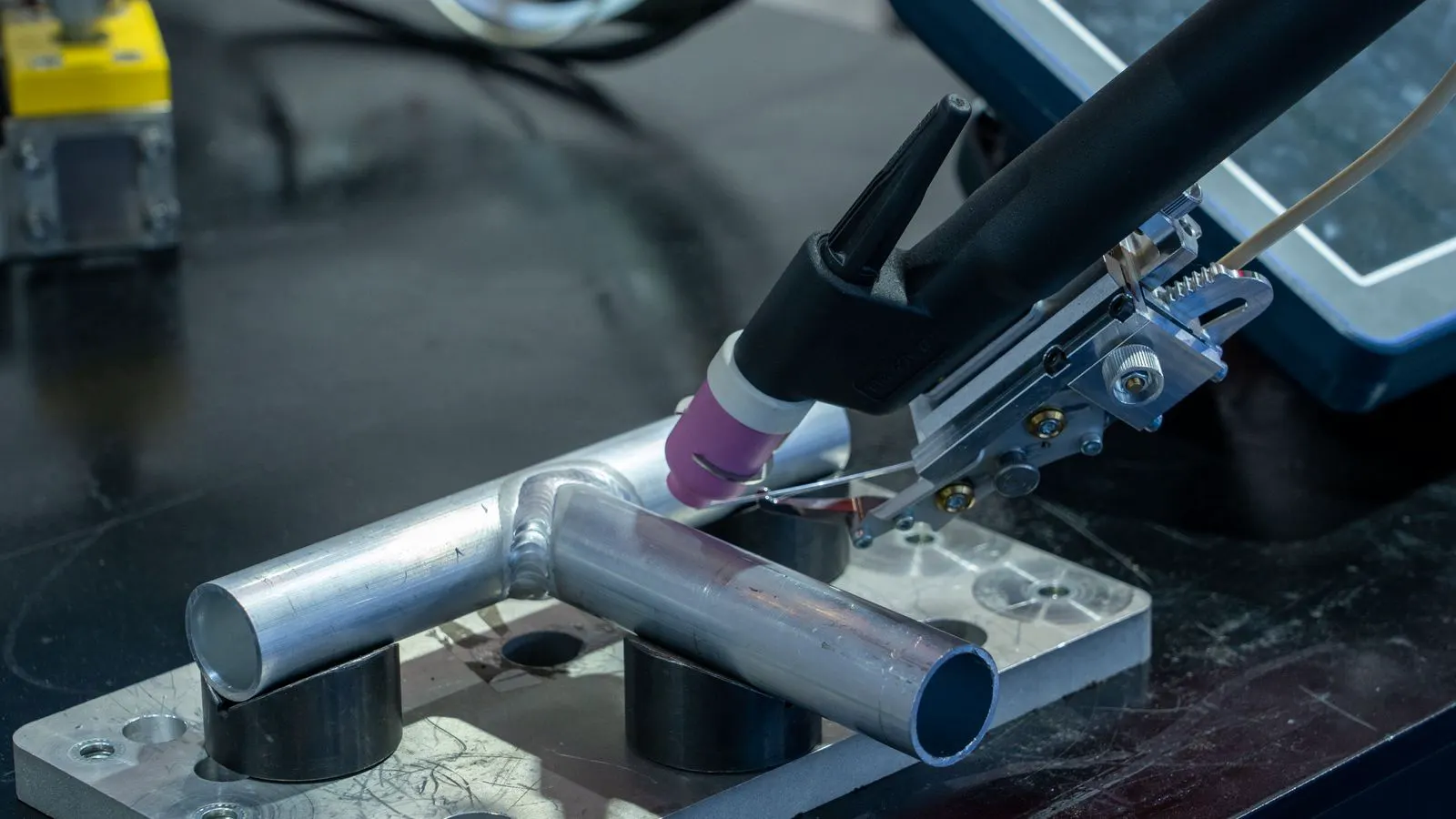
TIG welding uses a non-consumable tungsten electrode and a separate filler rod. The arc forms between the tungsten and the workpiece, and the operator manually feeds the filler into the molten pool. Argon gas shields the joint from atmospheric contamination.
For aluminum, AC TIG is the standard. The alternating current cleans the oxide layer at the start of each cycle and melts the base metal at the end. This balance produces a stable arc without excessive spatter. The heat input is controlled by the operator adjusting amperage, travel speed, and filler feeding.
TIG excels in situations where precision matters. Thin-walled profiles, such as architectural mullions or heat sink fins, tolerate low heat better with TIG. The operator can pause, restart, and change direction without leaving a visible crater or a string of spatter. The weld bead looks smooth and uniform, which matters for exposed architectural applications.
The process has real drawbacks. It is slow. A single long joint on a thick channel can take significantly longer to complete than the same joint run with MIG. The operator must maintain a steady hand and watch the pool closely, which makes it tiring over long production runs. Equipment costs are higher, and the setup for AC TIG is more complex than for standard DC processes.
How MIG Welding Works on Aluminum
MIG welding, also called GMAW, uses a continuous wire electrode that melts into the joint. The wire acts as both filler and electrode, and the gas shield protects the arc. For aluminum, the wire is typically pure aluminum or a 5xxx series filler, and the gas is almost always pure argon or a high-argon mix.
MIG delivers heat faster because the wire feeds continuously and the arc is more stable at higher amperages. The process is less sensitive to operator skill in terms of filler feeding, since the wire moves at a set speed. This makes it easier to maintain consistent results over long periods.
For thicker extrusions, such as structural channels, beams, or heavy-duty brackets, MIG often wins on productivity. The higher deposition rate means fewer passes are needed to fill a gap. The operator can weld at a faster travel speed and still maintain a sound joint.
The trade-offs are visible in the finish and heat management. MIG produces more spatter, a rougher bead surface, and a larger heat-affected zone. The higher heat input can distort thin profiles or warp long joints. Post-weld grinding or polishing may be needed to clean the surface. Setup also requires more preparation, including wire feeding adjustments and gas flow checks, which adds time at the start of each job.
TIG vs MIG Comparison for Extrusion Work
| Option | Best for | Limitations |
|---|---|---|
| TIG | Thin walls, visible joints, low distortion, repair work | Slow, high skill requirement, higher equipment cost |
| MIG | Thick sections, production runs, heavy structural work | More spatter, higher heat input, rougher finish |
| Pulsed TIG | Thin to medium walls, better penetration control | Slower than standard TIG, specialized equipment |
| Friction Stir Welding | Long seams, high strength, no filler | High setup cost, limited to specific joint geometries |
| Laser Welding | Precision, thin sections, automation | Expensive, requires tight fit-up, limited to thin materials |
When to Pick TIG for Extrusion Welding
Choose TIG when the joint is visible to the customer or when distortion must be minimized. Architectural frames, window and door profiles, heat exchangers, and aerospace components often require a clean, uniform surface. TIG delivers that finish without post-processing, which saves money over the life of the part.
TIG is also the right pick for thin-walled extrusions. If the wall thickness is under 3 mm, or if the section has thin webs and stiffeners, the low heat input of TIG prevents burn-through and warping. The operator can adjust the heat on the fly, which is critical when welding a complex profile with varying wall thicknesses.
Repair work is another strong case for TIG. A cracked joint or a small defect in a finished assembly is usually fixed with TIG because it allows precise, localized heat. The operator can target the defect without heating a large area of the surrounding profile.
If your project involves long production runs of identical joints, TIG may not be the most cost-effective choice. The labor cost adds up quickly, and the slower cycle time reduces throughput. In that scenario, MIG or an automated process may be more practical.
When to Pick MIG for Extrusion Welding
MIG is the better choice when speed and volume matter. Fabrication shops that produce many structural brackets, machine frames, or heavy-duty supports often use MIG because it deposits metal quickly. The operator can cover long joints without stopping to reload filler, and the arc is more forgiving of small fit-up variations.
Thick-walled extrusions, such as 8 mm or heavier channels, handle MIG heat input better than TIG. The larger cross-section absorbs the heat without significant distortion, and the higher deposition rate means fewer passes are needed. For butt joints with moderate gaps, MIG fills the space efficiently and produces a strong, continuous weld.
MIG also works well when joint accessibility is tight. The torch is smaller and more maneuverable than a TIG setup, which can be helpful in confined spaces or on long, continuous joints. The operator can weld in positions that are difficult with TIG, such as overhead or in narrow corners, with less fatigue.
The finish is less critical for MIG applications. If the joint will be painted, coated, or hidden inside a structure, the rougher bead and spatter are not a problem. In those cases, the productivity gain of MIG outweighs the extra cleanup time.
Practical Considerations Beyond the Process
The welding method is only one part of the decision. Fit-up is often the bigger factor. A poor fit-up with a large gap or uneven edges will fail regardless of whether you use TIG or MIG. Extruded profiles have precise tolerances, but handling during fabrication can shift them. Check the joint before welding and prepare the edges with a grinder or file if needed.
Gas shielding matters. Aluminum is reactive, and poor gas coverage creates porosity and weak joints. TIG requires a precise gas flow and proper torch angle. MIG needs adequate gas flow and a well-positioned nozzle. Both processes require dry, clean gas cylinders and leak-free connections.
Operator training is a major cost factor. TIG requires more skill to maintain a stable arc and control heat input. A new operator will struggle with thin joints and complex profiles. MIG is easier to learn but still requires practice to control spatter and heat. The cost of a skilled TIG welder is higher, and the availability of trained operators can limit your options.
Equipment choice also affects the outcome. A basic TIG machine may not handle thick sections well, and a MIG machine may lack the settings needed for aluminum. For extrusion work, look for equipment with AC capability for TIG and pulse settings for MIG. These features give you more control over heat input and penetration.
Common Mistakes and How to Avoid Them
The most common mistake with TIG is using too much heat. Operators often raise the amperage to melt the base metal faster, which causes burn-through and distortion. The fix is to use the lowest amperage that allows you to melt the joint and rely on travel speed and filler feeding to complete the weld.
For MIG, the most common error is using too little gas flow. This leads to oxidation and porosity. The gas shield must fully cover the arc and the molten pool. If you see a rainbow effect on the weld, the gas flow is too low or the torch is too far from the joint.
Another mistake is neglecting joint preparation. Aluminum oxide is harder than the base metal and can cause poor fusion if not removed. Clean the joint with a dedicated aluminum wire brush or a non-ferrous abrasive before welding. Do not use a brush that has contacted steel, as it introduces iron contamination.
Heat control is the third major issue. Long joints require periodic stops or backing bars to prevent warp. TIG operators often pause at intervals to let the metal cool. MIG operators may use a backing bar or clamp the joint to the worktable. Ignoring this leads to warped profiles that fail dimensional checks.
Final Decision Factors
The choice between TIG and MIG for extrusion welding methods comes down to a few practical questions. What is the wall thickness? Is the joint visible or hidden? How many joints need to be made? What is the fit-up quality? How much post-weld cleanup can you afford?
For thin, visible, or precision work, TIG is the safer bet. The finish is cleaner, the heat input is lower, and the distortion is easier to control. The cost is higher in labor and equipment, but the quality is justified for the right applications.
For thick, hidden, or high-volume work, MIG delivers faster results. The productivity gain offsets the extra cleanup, and the higher heat input is manageable in larger sections. The operator skill requirement is lower, which reduces training and turnover costs.
Many fabrication shops use both processes. They TIG the critical joints and use MIG for the bulk of the assembly. This hybrid approach balances quality and speed, and it is the most common practice in the industry. The key is to match the process to the part, not the other way around.
Frequently asked questions
Can MIG weld thin aluminum extrusions?
Yes, but it is difficult. Thin walls are prone to burn-through with MIG heat input. Use low amperage, short arc length, and a narrow nozzle. If distortion or burn-through is a concern, TIG is usually the better choice.
What is the best filler metal for aluminum extrusion welding?
For most extrusions, use a 5xxx series filler wire for MIG or a matching 5xxx rod for TIG. This matches the alloy of most architectural and structural extrusions. If the base metal is a 6xxx series, use a 5xxx filler to avoid hot cracking.
How much does TIG welding cost compared to MIG?
TIG typically costs more per joint due to slower travel speed and higher operator skill requirements. MIG is faster and easier to staff, so the labor cost is lower per hour. The total cost depends on the part size, volume, and finish requirements.
Can I use TIG and MIG on the same assembly?
Yes. It is common to use TIG for visible or critical joints and MIG for hidden or structural joints. Just ensure the filler metals are compatible and the heat input from each process does not weaken the surrounding metal.
What gas do I need for aluminum welding?
Use pure argon or a high-argon mix for both TIG and MIG. For MIG, a 98% argon and 2% helium mix can improve penetration in thicker sections. For TIG, pure argon is standard. Avoid oxygen or nitrogen in the gas mix, as they cause porosity and embrittlement.